


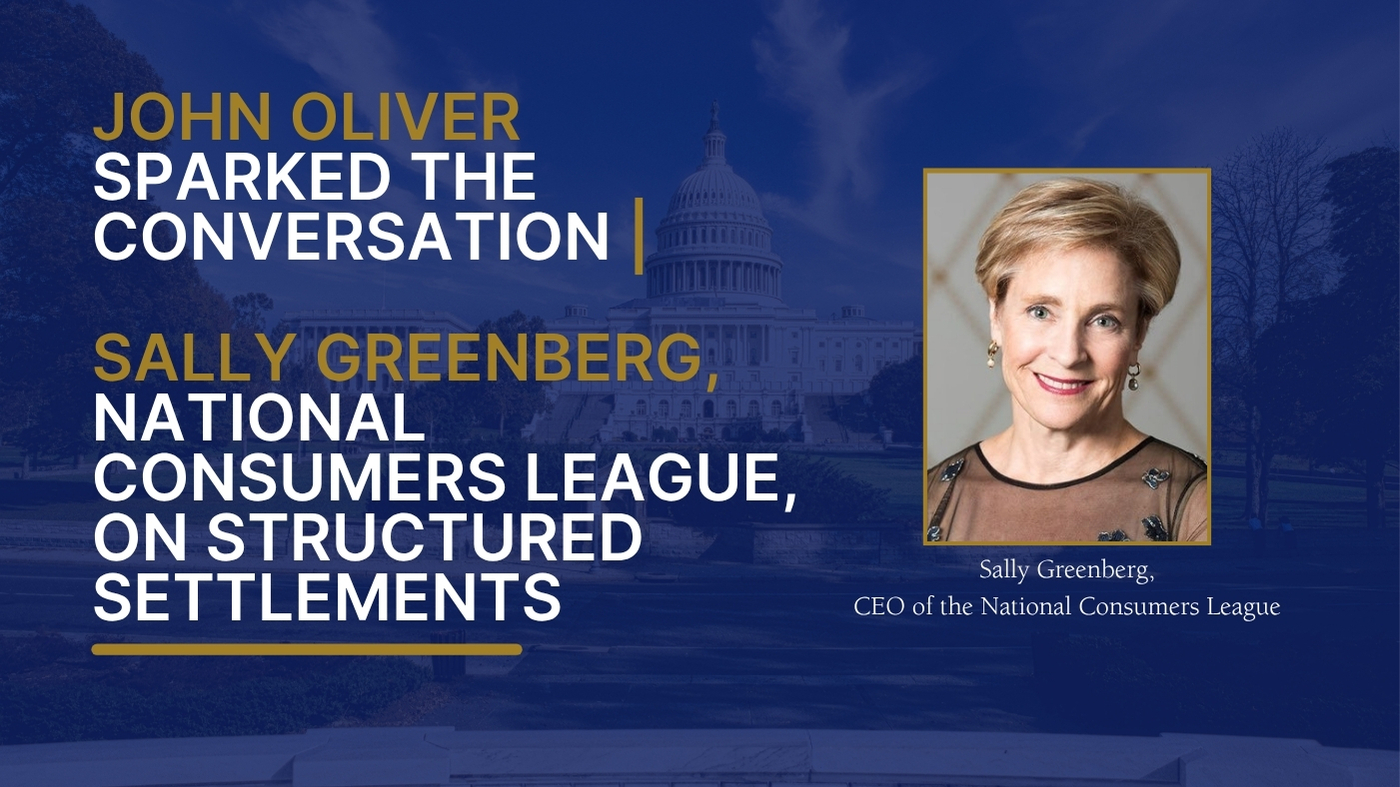
A recent episode of NSSTA’s Settle Smart series featured Sally Greenberg, Chief Executive Officer of the National Consumers League, in a conversation about a subject that has drawn renewed national attention: the secondary market that buys future settlement payments for a discounted lump sum. The renewed attention followed a segment on Last Week Tonight with John Oliver that examined factoring companies and the injured people they target. The discussion offered a practical answer to a question now facing legislators, judges, and regulators across the country: what actually works to protect injured people from predatory factoring.
The conversation drew a clear line between two very different things that audiences often confuse. A structured settlement is a protective, court-recognized instrument. Settlement factoring is the practice of purchasing those future payments. NSSTA examined the Last Week Tonight segment and the documented record behind it, including the investigative reporting, regulatory filings, and oversight gaps that preceded the broadcast, in a companion analysis on the NSSTA blog: Protecting Structured Settlements From Factoring Industry Abuses. This Settle Smart conversation focuses on the solutions side of that record: where state safeguards have proven effective, and what recipients and their families can do to preserve the long-term security a structured settlement is designed to provide.
What is a structured settlement, and what is settlement factoring?
A structured settlement resolves a personal injury, wrongful death, or similar claim through a stream of guaranteed periodic payments rather than a single lump sum. Payments are funded by highly rated life insurance company annuities, and under Section 104(a)(2) of the Internal Revenue Code, they are exempt from federal and state income tax. The payment schedule can be tailored to a person’s long-term medical and living needs, and federal law has recognized the use of these arrangements for injured parties, including minors, for decades.
Settlement factoring is a separate, secondary-market activity. A factoring company offers a recipient cash today in exchange for the right to collect that person’s future payments. As the episode emphasized, the lump sum a recipient receives is typically far less than the total value of the payments surrendered.
Why does settlement factoring draw consumer-protection concerns?
In the episode, Greenberg framed the issue in terms familiar to consumer advocates: protecting people who are not positioned to evaluate complex financial transactions on their own. The conversation described how factoring marketing can be aggressive and emotionally persuasive, and how it frequently reaches recipients who are cognitively impaired, who come from limited financial backgrounds, or who face pressure from family members in need.
The discussion pointed to a particularly troubling sales logic surfaced in the national segment: that a recipient’s essential needs are already met by the periodic payments, so the pitch instead targets wants. The participants characterized that approach as a deliberate effort to persuade people to trade guaranteed lifetime security for short-term, discretionary purchases.
The episode also referenced the case of Freddie Gray of Baltimore as an illustration of the human cost. According to the conversation, payments intended to provide for his future were sold off repeatedly over a period of years, leaving little behind. The participants used that account to underscore why repeat transactions, in particular, can rapidly erode a recipient’s financial foundation.
How effective are state protections? The Maryland example
The conversation identified Maryland as a case study in what disciplined safeguards can accomplish. Greenberg recounted the work she and partners undertook with the state’s then Attorney General, Brian Frosh, to put guardrails around factoring activity. The result was striking: Maryland reduced predatory settlement factoring transactions from approximately 1,800 in a single year to just six the year after stronger guardrails took effect.
The participants attributed that result to meaningful judicial review. When a recipient must appear before a judge in their own jurisdiction and answer direct questions, such as whether this is a first or a repeat transaction and how they intend to meet their obligations after selling future payments, courts gain the ability to slow or stop transactions that are not in the person’s interest. The episode noted that judges have sometimes expressed discomfort approving these transfers under existing law, which reinforces the case for giving courts clearer authority to intervene.
Why are younger recipients especially at risk?
A recurring theme was the vulnerability of recipients who receive structured settlements as minors. The conversation described how some factoring companies review public court records to identify these individuals and then contact them once they reach adulthood, often before they have developed financial experience or have family guidance in place.
In response, advocates are pursuing measures in several states, including Ohio, Oregon, and California, that would limit the personal information, such as a recipient’s name, address, and date of birth, made available through court records. The intent, as explained in the episode, is to make it harder for companies to locate and solicit young recipients during a period when they are least prepared to evaluate such offers.
What can recipients and families do before selling future payments?
The clearest guidance from the conversation was direct: before considering any offer to sell future payments, a recipient should return to the qualified professional who helped establish the arrangement, or to another reputable source, for independent advice. The participants emphasized that legitimate structured settlement consultants build plans around a person’s actual needs and can often help address a genuine short-term cash requirement without surrendering guaranteed lifetime payments.
The episode noted that NSSTA’s membership of structured settlement consultants operates under a code of ethics and that consultants routinely set aside a portion of a settlement in accessible form to cover near-term and unforeseen expenses. The periodic payments, by contrast, are designed to remain in place for the long term, which is precisely what makes them worth protecting.
How does education help prevent harm?
The discussion also turned to prevention through financial literacy. Greenberg described the National Consumers League’s LifeSmarts program, a free consumer-education and financial-literacy initiative for students, available at lifesmarts.org, that teaches young people to recognize common scams and to understand financial instruments, including structured settlements. The participants discussed the potential for NSSTA and the League to collaborate so that more students understand the value of a guaranteed annuity and the risks of giving it away.
The path forward
The episode closed on a forward-looking note. The participants described continued work to strengthen Structured Settlement Protection Acts across multiple states, to equip judges with better tools to evaluate proposed transfers, and to raise public awareness so that recipients recognize predatory solicitations for what they are. The shared conclusion was that the most reliable defense is a combination of strong state law, meaningful judicial review, and consumer education, reinforced by an industry committed to acting in recipients’ long-term interest.
For NSSTA, the takeaway is consistent with its longstanding mission. A structured settlement exists to deliver security and dignity over a lifetime. Protecting that promise, through sound public policy and trustworthy professional guidance, remains the priority.
Frequently Asked Questions
What is settlement factoring? Settlement factoring is a secondary-market transaction in which a company purchases a person’s future settlement payments in exchange for a lump sum of cash today. That lump sum is generally far less than the total value of the payments the recipient gives up.
Are structured settlement payments taxed? No. Under Section 104(a)(2) of the Internal Revenue Code, periodic payments from a structured settlement for physical injury claims are exempt from federal and state income tax.
Why would someone consider selling their future payments? Recipients are often approached with offers of immediate cash, frequently to cover a perceived want rather than an essential need. Because the payments are guaranteed and tax-free, surrendering them for a discounted lump sum usually leaves the recipient with substantially less value over time.
What legal protections exist for recipients? Most states have enacted Structured Settlement Protection Acts, which generally require a judge to review and approve any transfer of future payments. As discussed in the episode, the effectiveness of these laws depends heavily on the quality of judicial review and the questions courts are empowered to ask.
What should I do if I need cash before selling my payments? Speak first with the qualified structured settlement consultant who helped establish your arrangement, or with another reputable, independent advisor. A legitimate professional can help you weigh your options and may be able to address a genuine short-term need without requiring you to give up your guaranteed future payments.